17 Believe in Yourself Quotes to Boost Your Self Confidence


If you’re living with chronic illness, you’ve probably tried every coping strategy in the book. Build healthy habits, lower your stress levels, get enough rest. Monitor your health, manage your symptoms and pace your energy. Explain your limitations to the people in your life and ask for support. Oh, and don’t forget to stay positive during this whole process.
I’ve written before about the basic coping strategies to deal with the emotional rollercoaster of being sick. But here’s the truth: sometimes the standard advice only gets you so far. Sometimes you need to try counterintuitive ways to cope with chronic illness.
In my own life, there have been times when I’ve had to throw all the disease-management rules out of the window and push through pain, fatigue and brain fog to reach important goals or make special memories.
And when new, scary symptoms pop up, practicing mindfulness sounds zen, but it can make me even more aware of every sensation in my body, triggering unhelpful rumination about what could be causing these health problems. Distracting myself with comfort TV series and mindless scrolling turns out to be a much more effective strategy to manage stress-inducing symptoms in the moment – even if that is not a healthy habit in the long run.
This is where counterintuitive coping strategies come in. They may not seem logical at first glance, or even feel ‘wrong’ compared to what you’ve been told about self-care and pain management. But the realistic way to cope with chronic illness in everyday life isn’t always the conventional wisdom found in medical literature.
Not every strategy mentioned will work for everyone, but hopefully these tips below will give you some new ideas to adapt the standard advice to your unique situation.
With that in mind, take a look at 10 counterintuitive ways to cope with chronic illness that actually do work.
So many of us are told to “just stay positive” to cope with chronic illness. And that’s not bad advice, because an optimistic mindset is not just linked to better mental health, but also to a stronger immunity, healthier heart and less pain.
But constantly pretending everything is fine when you feel sick, sad and stressed is exhausting, and not that healthy either. Giving yourself permission to not be okay is more healing than forcing yourself to smile through your tears.
Instead of this toxic positivity, allow yourself to feel the full range of emotions, whether that’s helplessness, anxiety for what the future may hold or anger because life’s unfair sometimes. As long as you express your feelings in a non-harmful way and do not get stuck in a negative state of mind, it’s completely normal to struggle with serious problems.
If you do want to feel more positive, in a healthy way that acknowledges the reality of living with chronic illness, here are some helpful strategies to let go of unhelpful thought patterns or to convey genuine optimism.
Keeping track of your symptoms and potential triggers with health apps or medical journals can be very helpful, especially when you’ve recently been diagnosed with chronic illness. It can help you uncover patterns and fluctuations of your illness and take proactive steps to manage your health, as well as provide valuable information about your condition to your doctors.
But hyper-focusing on every sensation in your body can also fuel health anxiety. Your brain may unconsciously become highly aware of (normal) bodily signals, like a faster heart beat or breathlessness, making you worry even more. What’s more your brain could start to process internal sensations differently, which actually worsens your symptoms.
In that case, the healthiest thing you can do is step away from monitoring your health. Sometimes less data means less distress.
Explore different ways to listen to your body and learn how you can recognize warning signs that urge you to stop and rest, instead of pushing through the pain.
If you’ve ever been in serious pain, you know you’d do pretty much anything to prevent that from happening again. But when you’re living with chronic illness, you can’t avoid pain at all costs.
Why? Well, first of all, because you will probably fail. If it were that easy to not be in pain, we’d be doing it already.
But more so, sometimes other things in life are more important. You want to have fun with your friends, even if you have to pay the price later. You want to do what’s within your control to attend your sibling’s wedding or your child’s graduation. Maybe you have to push through discomfort to follow vital medical treatments, therapies and movements sessions to slowly rebuild your health over time.
So even though it sounds like a counterintuitive way to cope with chronic illness, you may sometimes have to accept some pain (sometimes and some being important keywords here!) to live a fuller, more connected life.
But only combined with the next strategy….

I know, taking it easy when you’re finally feeling ok is a huge buzzkill. You want to enjoy the moment or take advantage of this small burst of energy to get things done.
But if you over do it on relatively good days, chances are you’re dealing with post-exertion malaise or a flare-up of symptoms afterwards. To avoid getting stuck in this push-and-crash cycle, it’s helpful to build in rest, even when you’re not exhausted.
Pacing your energy can help make your illness a little less unpredictable, so you could actually be more ‘productive’ in the long run. Depending on your condition, you could plan breaks before and after activities, switch between mental and physical tasks or leave room for rest days. Whatever strategy works best for you, try to stop yourself before you run out of energy, and explore what helps you to recharge your body and mind.
Take a look at why chilling on the couch isn’t necessarily real rest, and what you can do to make rest days more enjoyable and effective.
With that in mind…
During times of crisis, people often say “let me know if I can do something for you”, but still many of us find it hard to ask for help, let alone when you seem to be doing much better already.
But even when the immediate emergency has passed, you need time to process and bounce back from being rushed to the hospital, experiencing scary symptoms or getting a diagnosis that turns your world upside down.
To avoid emotional overwhelm and physical burnout during that phase after a health crisis (big or small), it’s perfectly ok to ask for practical support with running errands, cleaning the home, doing admin work or caring for kids or pets. Don’t wait until you crash again to reach out to family, friends, neighbors or paid assistance to get the help you need.
Check out more tips to mobile your support system in ways that work well for both parties involved, and how you can still maintain a sense of independence when you rely on others for help.
Anger, sadness, loneliness and jealousy often get labeled as “negative” emotions, but they are normal reactions to living with chronic pain, brain fog and daily exhaustion. Suppressing these feelings often works as a boomerang – they come back to hit you in the face.
More so, experiencing and accepting negative emotions is actually important to your mental health. Without anxiety or digest warning you for dangerous people, situations or foods, you wouldn’t survive. Feelings like frustration, envy and boredom also point out important needs and urge you to take action.
Pushing away difficult thoughts and emotions can lead to unhelpful behaviors like overeating junkfood, drinking one too many glasses of wine or endless video gaming.
On the other hand, acknowledging and processing your feelings through talking, journaling, moving your body, working with your hands or taking proactive steps to improve your situation can help you move past your pain.
So grieve your old self and mourn the life you thought you’d have. Get angry, constructively. Advocate for your health, set healthy boundaries or express yourself creatively, instead of bottling up your emotions. Just sit with feelings of hopelessness and bitter-sweetness, so you can let it go or take action.
Don’t let anyone (including yourself) tell you that difficult emotions are bad or a sign of weakness. Emotional wellbeing encompasses the full spectrum of emotions. And like Brené Brown says,
‘We cannot selectively numb emotions. When we numb the painful emotions, we also numb the positive emotions.’
We all know that endlessly scrolling your phone and binge-watching TV series is not the best thing to do for your physical health and emotional wellbeing. Excessive screen time strains your eyes, cause tension headaches and poor posture, affect your quality of sleep, harm your mental health and take up too much of your already limited energy.
But on days when you’re completely exhausted or your symptoms are flaring up, distracting yourself with easy entertainment might be just what you need to get through the day. Research shows that digital escapism through gaming or watching videos can reduce acute pain and improve your mood.
Sure, there are many other fun, low-energy activities you can do when you’re bored and sick at home, but sometimes watching cute cat videos or playing Candy Crush will bring you the comfort you need without worsening your symptoms.
You can even turn your screen time into an international coping strategy by making a list of fun shows, inspiring movies, distracting games or uplifting websites that help take your mind off your pain for a moment.
… well, not strict ones. Over the past decade, we’ve been bombarded with the very best routines to kickstart your morning, be highly productive during the day, live a healthy lifestyle even when your busy, and set yourself up for success the next day by preparing the evening beforehand.
And that can be great! But rigid routines often do not match well with the unpredictability of chronic illness. If your symptoms fluctuate from day to day – or even from hour to hour – it may be impossible to stick to healthy habits. Who wants to have green smoothies for breakfast when you’re extremely nauseous, meditate with migraine or workout after an asthma attack?
Instead of following a strict schedule, you could create flexible rituals that you can easily adapt to your current conditions. Maybe you can still move your body when not not feeling that well, but instead of the more intense activity you had planned, you go for a walk, do some gentle exercises in bed or practice ground movement.
By using “if-then” planning or having a backup plan for bad days, you will create more sustainable rituals. That way, you can still make small but consistent progress on goals that are important to you, without the self-doubt and guilt.
In that same spirit…
… at least not every aspect of it, all the time. Don’t get me wrong, I strongly believe that taking your health into your own hands can be empowering and get you results. ‘Optimizing’ your health routines can even be helpful for a specific period of time when you’re fully focused on your recovery.
But when your illness turns chronic, and the months turn into years, you also need space to actually live your life, not only try to prepare for that moment in the future that you can hopefully feel a little better again. You don’t want to miss out on every birthday cake or tiring but fun event because you have to stick to your diet, exercise program or sleep schedule all the time – not when you’ve already had to cancel enough plans because you were too sick to go.
Even more important: it’s completely ok – even celebrated – to be human. If you started reading self-help books or following wellness influencers online to boost your health, it’s easy to get sucked into a mindset of self-improvement. But your life is not a project, you don’t have to tweak or upgrade every aspect of your health, personality or daily habits.
You are enough just the way you are, with your quirks and imperfections, because that’s exactly what makes you you.
Everyone’s experience with illness is different, even in people with the same health problems. No one can read your mind (thankfully), so the people around you need to have some information about the symptoms you’re facing and how that affects your daily life, in order to be able to support you and make adjustments.
Sadly, no matter how well you explain it, not everyone will get what it’s like to live with pain and debilitating symptoms every day. And as much as it hurts, freeing yourself from the hopes of being fully understood by every person in your life will eventually lighten your emotional load. As long as you have someone you can talk to, who’s got your back through it all, you don’t need their acknowledgment and approval.
I used to think having a hard-to-grasp disease without medical consensus of the cause like ME/CFS and fibromyalgia is what made people doubt the validity and severity of my symptoms. That changed when a girl with a brain tumor told me how your manager did not understand why she needed to work less hours during the months following her brain surgery. That shocking lack of imagination and empathy made me realize that some people will just never understand what it’s like to be seriously sick until they’ve been in that situation themselves.
If you have ignorant or judgmental people like that in your life, please stop explaining or excusing yourself once you’ve put in the effort to communicate your limitations. Focus your limited energy of the family members, friends or fellow spoonies who do try to understand what it’s like to be in your shoes.
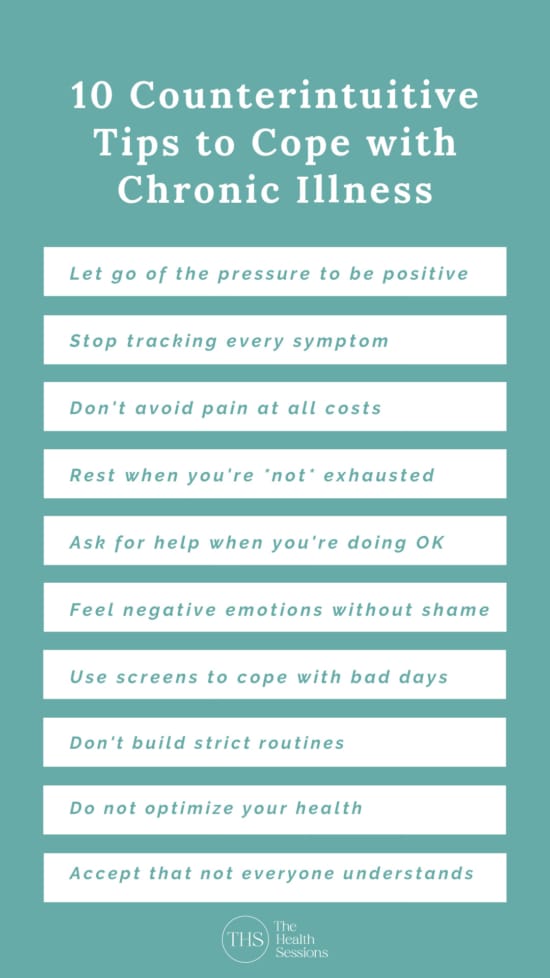
There are many tips available to deal with the physical, mental, emotional and practical aspects of health problems, and what works for you depends on your particular illness and personal situation. But I hope these 10 counterintuitive ways to cope with chronic illness have shown you that it’s ok to ditch the ‘rules’ sometimes and explore what’s right for you.
Tell me, which counterintuitive coping strategies have you helped you deal with tough times?
For more advice on living a good life with chronic illness, sign up for the free newsletter from The Health Sessions , delivered straight to your inbox.