How to Reduce Ultra-Processed Foods When You’re Too Tired to Cook

This article contains some affiliate links to resources you may find useful, at no extra costs to you. All opinions are my own.
At the start of a new year or season, there’s a lot of excitement around motivational slogans and challenges. Whether you get inspired by David Goggins’ “Can’t Hurt Me”, doing 75 Hard or taking cold showers every day, all these ideas are centered around self-discipline and pushing yourself hard to reach your full potential.
But at the same time, we hear – or experience ourselves – how hustle culture burns people out, mental health problems are skyrocketing and too many of us feel tired and overwhelmed. That’s why some people are longing for more self-care, more softness, more time for relaxation and letting go of the idea that you have to be productive all the time to be ‘successful’.
It made me wonder: If you want to reach your goals this year, what exactly is the right approach?
Should you be disciplined, put your head down and get to work consistently, no matter how you feel that day? Or do you choose gentler strategies to get to where you want to go, while listening to what your body and mind need in the moment?
Well, that doesn’t just depend on your personality and health, but also on the specific situation you find yourself in. You see, when I was a teenage girl and young adult living with juvenile rheumatism, fibromyalgia and ME/CFS, I found developing a ‘spoonie warrior mindset’ very helpful. Without that drive, I don’t know if I would have found the inner strength I needed to push through the pain to self-study my way to my degrees, to work on my recovery and create a meaningful life for myself.
But now that I’ve done plenty of hard things in my life and have a family to look after, I don’t always have the physical energy nor the desire to get into that state of mind again. My daily life already contains enough moments when I’m stretching my physical, mental and emotional limits. So if, on top of that, I want to do the long-term work to achieve important goals, I also need enough restoration and gentleness towards myself.
When it comes to self-discipline versus self-care, there’s no wrong or right way, they’re just different strategies for different wants, needs and stages of life.
Let’s take a look at the pros and cons of each approach, so you can decide for yourself what’s best for you right now.
We all know what we should be doing to get healthier, boost our happiness and go after our ambitions. But actually doing those things, that’s a lot harder when you’re tired and overwhelmed, when don’t feel like moving your body and making a salad, when it’s chilly and rainy outside and you’d rather curl up on the couch with a good book.
For self-discipline, consistency is key. You show up to do the work, even if you don’t feel like it. You make a step-by-step plan to reach your goals and you follow through, regardless of the specific situation you find yourself in that day. In fact, ideally you prepare for the obstacles that could stop you from sticking to your desired behaviors, with if-then planning (“If this happens, then I’ll do….“) and practical solutions, like having healthy meals in the freezer on days when you’re too busy or exhausted to cook.
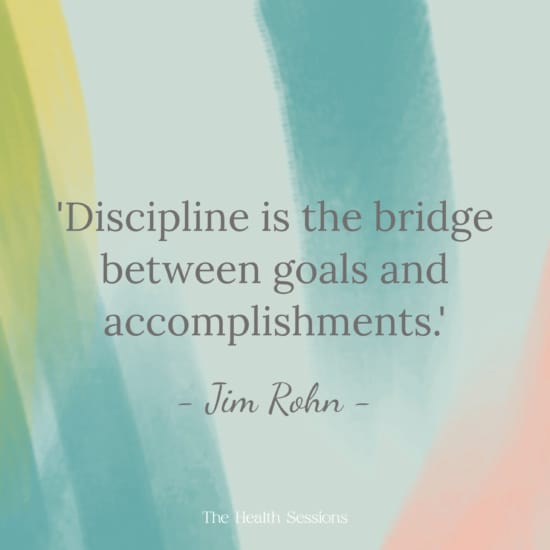
‘Discipline is the bridge between goals and accomplishments.’ – Jim Rohn
Self-discipline is closely tied to self-improvement, the desire to make yourself better in one or more areas of life. You often need some form of discipline to accomplish measurable, time-bound goals like losing 10 kg, reading one book a month or saving €500 for a weekend away.
Having discipline won’t just help you accomplish things, but it can also shift your mindset. Being able to stick to your routines, no matter what, will change the way you think about yourself: not as a victim of circumstances, but as someone who can do hard things and has some control over the direction of their life. That inner belief forms a solid foundation to tackle more big, bold goals.
When you’re going after your goals in a disciplined way, it’s helpful to fuel your motivation regularly. Watch the training scenes in Hustle or Rocky, listen to songs that get you fired up, read biographies of people who’ve survived or thrived against all odds.
But be aware that you can’t rely on motivation and willpower alone. As most of us have experienced, you can run out of willpower after a stressful day, so you may still struggle to resist those potato chips late at night. Discipline also means that you change your environment to make it easier to perform the behavior you want to do, like placing healthy snacks where you see and grab them, and make it harder to give in to temptations (so hide those cookies!).
Also, don’t overlook the inner work you may need to do to make changes stick over time. No matter how well you follow your planned schedule, you are not a machine. What’s more, the behaviour you want to improve through discipline may be the result of hidden trauma, inner beliefs about your self-worth or stubborn patterns from your past. Those underlying ‘obstacles’ may not show up right away, but they are often strong and persistent enough to pop up again during times of stress and hardship. That’s why it can be helpful to also understand why you’re overeating, procrastinating or spend hours a day on social media, instead of only changing our habits.
And remember: you don’t have to go all-in all the time! Yes, the winter arc challenge, online business gurus and fitness experts may all tell you that you need to be 100% dedicated to reach your dreams, but that still includes making time to relax your body and quiet your mind. It’s great if you want to join the 5am club and start your day with movement, meditation or ice baths – but only after you’ve gotten enough sleep. You can’t pour from an empty cup, so make sure you don’t end up burning yourself out in the quest for self-improvement.
With that in mind, consider working in sprints. Meaning, you do short, more intense projects or challenges within a set time frame, followed by a few weeks ‘off’ to relax and recharge before taking on a new project/challenge. Think of writing 1,667 words a day for National Novel Writing Month each November or tackling a monthly challenge like Dry January. Working in sprints can be a great way to keep your motivation and energy high, while getting meaningful things done.
Finally, celebrate the victories along the way. Use simple tools like a calendar or bullet journal to track daily habits, and reward yourself for sticking to your plans or reaching certain milestones. You could also take on fun virtual challenges like ‘walking the Inca trail’ or ‘hiking Mount Kilimanjaro’ to stay motivated with your fitness goals and win a beautiful medal upon completion.
‘Discipline is choosing between what you want now and what you want most.’ – Abraham Lincoln
Self-care can be the goal, as well as a gentle tool to achieve your goals. Maybe you’re striving for less stress in your life, more time for self-reflection, mindfulness and meaningful hobbies. Perhaps you want to spend more time in nature, learn how to cook new healthy recipes or up your wellness game. You can also still have more ‘traditional’ ambitions like getting a promotion or running a race, but you do also care about having an enjoyable or meaningful experience too, not just if you end up where you wanted to go.
‘Self-care is not self-indulgence, it’s self-preservation.’ – Audre Lorde
The self-care approach to reach your dreams is based on the assumption that you’re enough as you are right now, even if life isn’t ideal. Sure, you may want to feel healthier and happier and do things that are important to you, but there is some level of acceptance of your current situation.
And instead of relying on strict plans or external measurements like the number of steps taken, calories eaten or pages read, you let your inner voice and body’s wisdom guide you. Not in a woo-woo way, but by taking into account how you’re feeling physically and emotionally when you make plans for the day. You try to fit your goals into your existing lifestyle, instead of revolving your life around achieving your goals.
Are you in your soft self-care era? You can set some gentle goals for yourself that support your overall wellbeing, like creating relaxing evening routines to wind down before bedtime to improve your sleep. You could take up gratitude journaling to change your thinking patterns and brighten your mood, spend some time in the woods each month to boost your immunity, or try new herbal tea recipes.
If you’re in need of relaxation, make sure you’re getting real rest – and not just the ‘laying on the couch flipping the channels’ kind. You need activities that release tension from your muscles, slow down your breathing and heart rate, and quiet your racing mind. Think of a warm bath, restorative yoga, mindfulness exercises, even singing – whatever triggers your natural relaxation response. Soothing your nervous system and calming your mind are two self-care strategies that form the foundation for feeling healthier and happier.
‘Almost anything will work again if you unplug it for a few minutes, including you.’ – Anne Lamott
When you want to accomplish goals that are meaningful to you, do keep moving forward, even if you’re moving at a slow pace. Don’t get discouraged by your moderate progress. Like Earl Nightingale said, ‘Never give up on a dream just because of the time it will take to accomplish it. The time will pass anyway.’ So take as much breaks as you need, but don’t stagnate completely. Keep taking tiny steps towards your goals.
This is especially important for health-related goals with chronic illness, because you don’t want to end up in a vicious cycle of deconditioning, when you lose muscle mass or certain physical abilities due to inactivity, which in turn makes it even harder to move your body well enough to regain your fitness. From a self-care approach, you do make yourself move your body regularly, but you decide in the moment if you want to do serious strength training, some cozy cardio of that gentle stretching in bed is all you can muster today.
And lastly, make your journey as enjoyable as possible. To me, self-care is the opposite of the ‘no pain, no gain’ mentality. Instead, listen to audiobooks while cooking new nutrient-rich recipes. Treat yourself to a healthy hot chocolate after going for your daily walk despite being tired and have a relaxing Epsom salt bath after a stressful day. It can also be helpful to get a journal for self-reflection, exploration and accountability.
Thankfully, real life isn’t as black and white as (social) media picture it to be. You don’t have to choose between being a tough gym bro following strict health protocols, taking ice baths and doing extreme challenges on one hand, or being a soft, nature-loving yogi who enjoys journaling and candlelit bubble baths. You can have a little bit of both self-discipline and self-care.
You can start small, building one daily habit at a time at your own pace and creating a routine that doesn’t feel forced or restrictive, but actually frees up energy. You could be disciplined in some areas of your life, and practice self-care in others. You can take a disciplined approach throughout the (work) day, while focusing on recovery, relaxation and slow living in the evening and weekends. Whatever works best for you.
There is no wrong or right approach to going after your goals, it simply depends on what suits your personality, specific situation and timing best.
And don’t forget: you can mix and match! You can practice self-discipline in your work life or with your finances, but be gentle with yourself when it comes to your downtime, your health or rebuilding your fitness to prevent injury or PEM.
Do you have a preference for self-discipline or self-care when it comes to reaching your dreams?
You can learn more about pursuing your dreams and setting realistic goals when you’re chronically ill by clicking the links.
Or sign up for free weekly updates from The Health Sessions to start living a good life with chronic illness, despite the problems you might be facing.